DensityDesign Lab · Politecnico di Milano · Data design · 2022 — 23
A Highway to Greenness.
How car brands make their adverts look green, without saying it.
Adverts read frame by frame
Findings, each traceable
Pages in the report · 4 videos and a website
In a team of seven
Role, team and links 6 facts · the report · the website
At Politecnico di Milano’s DensityDesign Lab, our team of seven asked how car brands make their models look green on YouTube. We studied 90 adverts and turned the answer into a 60-page report and Automotifs, a website of supercuts and video collages. Read the report · Visit Automotifs
| My role | Research, data storytelling and video |
| Timeline | Autumn 2022 — February 2023 |
| Team | Haleh Nobar, Andrea Benedetto, Simone Cerea, Camilla Guerci, Surabhi Gupta, Alessandro Pedriali, Yousef Taffal |
| Tools | Premiere Pro, After Effects, YouTube Data Tools, RAWGraphs, OCR, Read-o-Meter, computer vision |
| Status | Course project; report and website published |
01 — See
Car brands are accused of greenwashing, yet their adverts rarely make bold green claims. They show it, in landscapes, stories and fine print too fast to read.
We slowed 90 adverts down, 30 each for petrol, hybrid and electric, and read every one three times, each time with a new question.
Q1
Where is the car shown?
Q2
How is its story told?
Q3
How is it described?
The sample
90 fleeting adverts, turned into countable evidence: 30 petrol, 30 hybrid, 30 electric.
Pattern 1 · Q1 · Finding 04
Greenery in shot: half or more of every engine’s adverts.
Pattern 2 · Q2 · Strategy 1
The car as the solution.
Pattern 3 · Q2 · Strategy 2
Green lifestyles.
Pattern 4 · Q2 · Strategy 3
Visual metaphors.
Pattern 5 · Q2 · Strategy 4
Fine print too fast to read. The four narrative strategies are rarer, yet no engine is free of them.
Adverts showing each pattern, out of 30 per engine. Counts from the report; the dots show how many, not which.
02 — Understand
Thirteen findings, each traceable to its data.
Three questions, each answered with its own method. For each one: what we saw, then its most consequential finding, as the report’s conclusion weighs them.
Question 01 · Environments · 4 findings
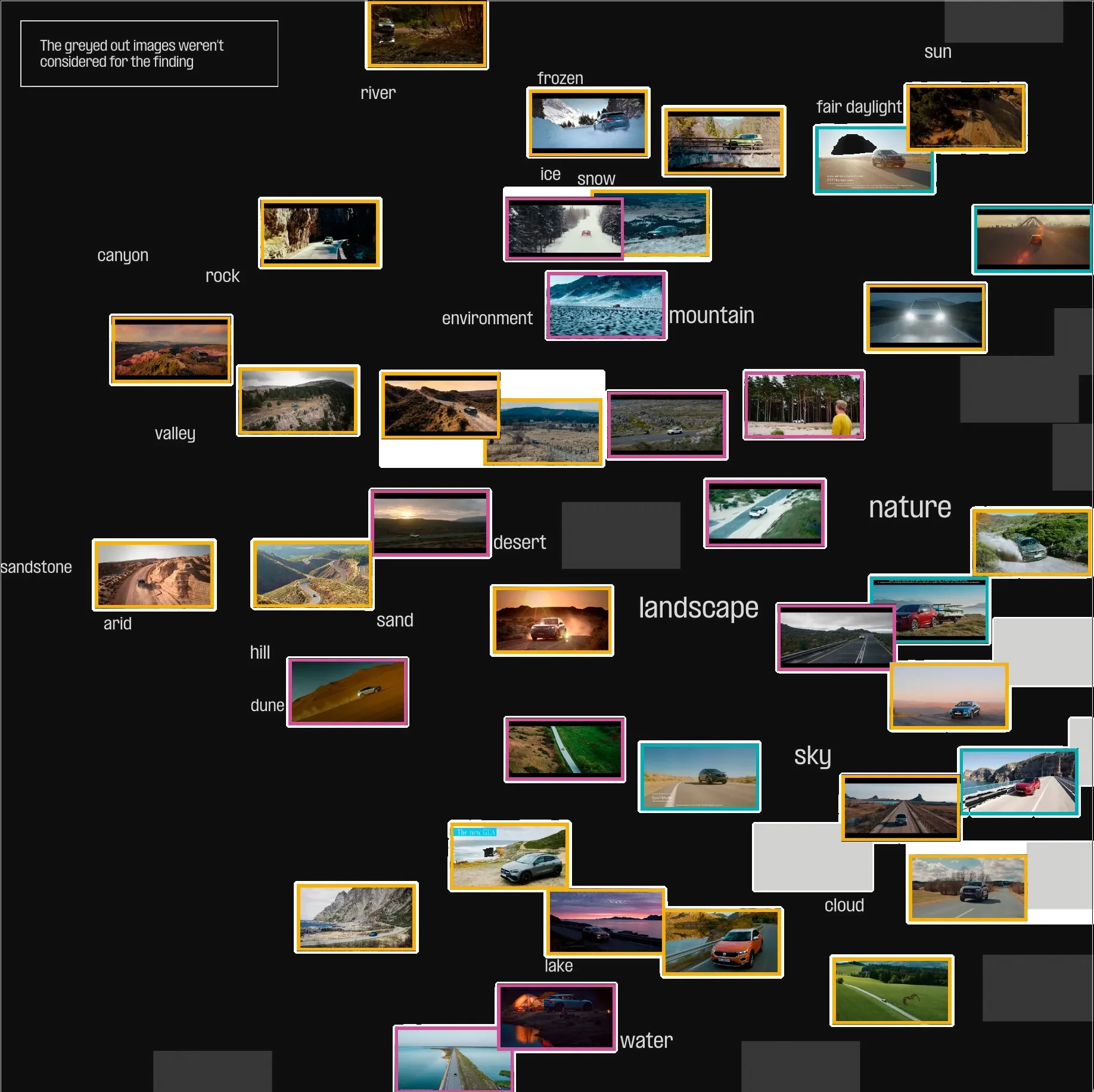
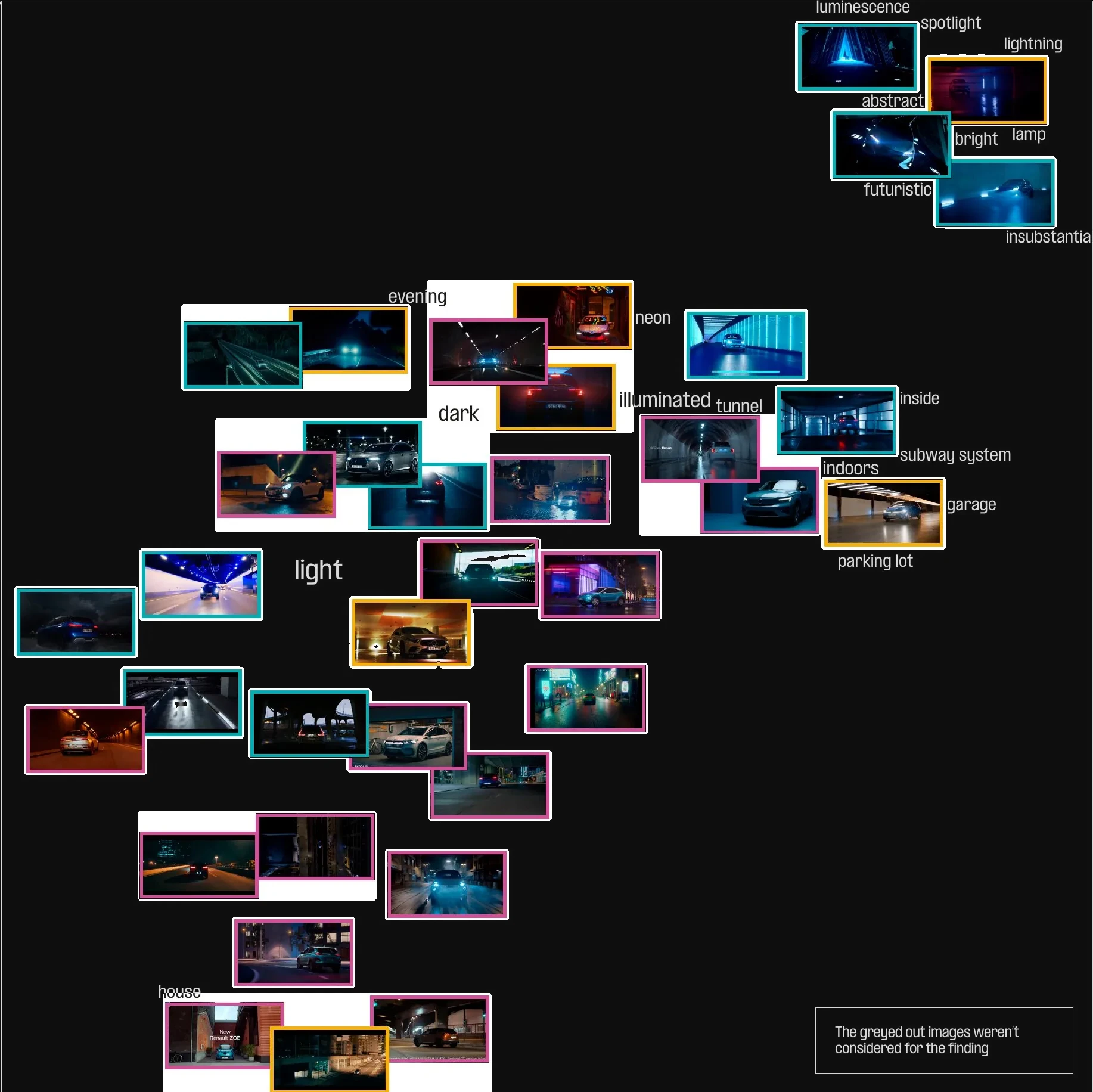
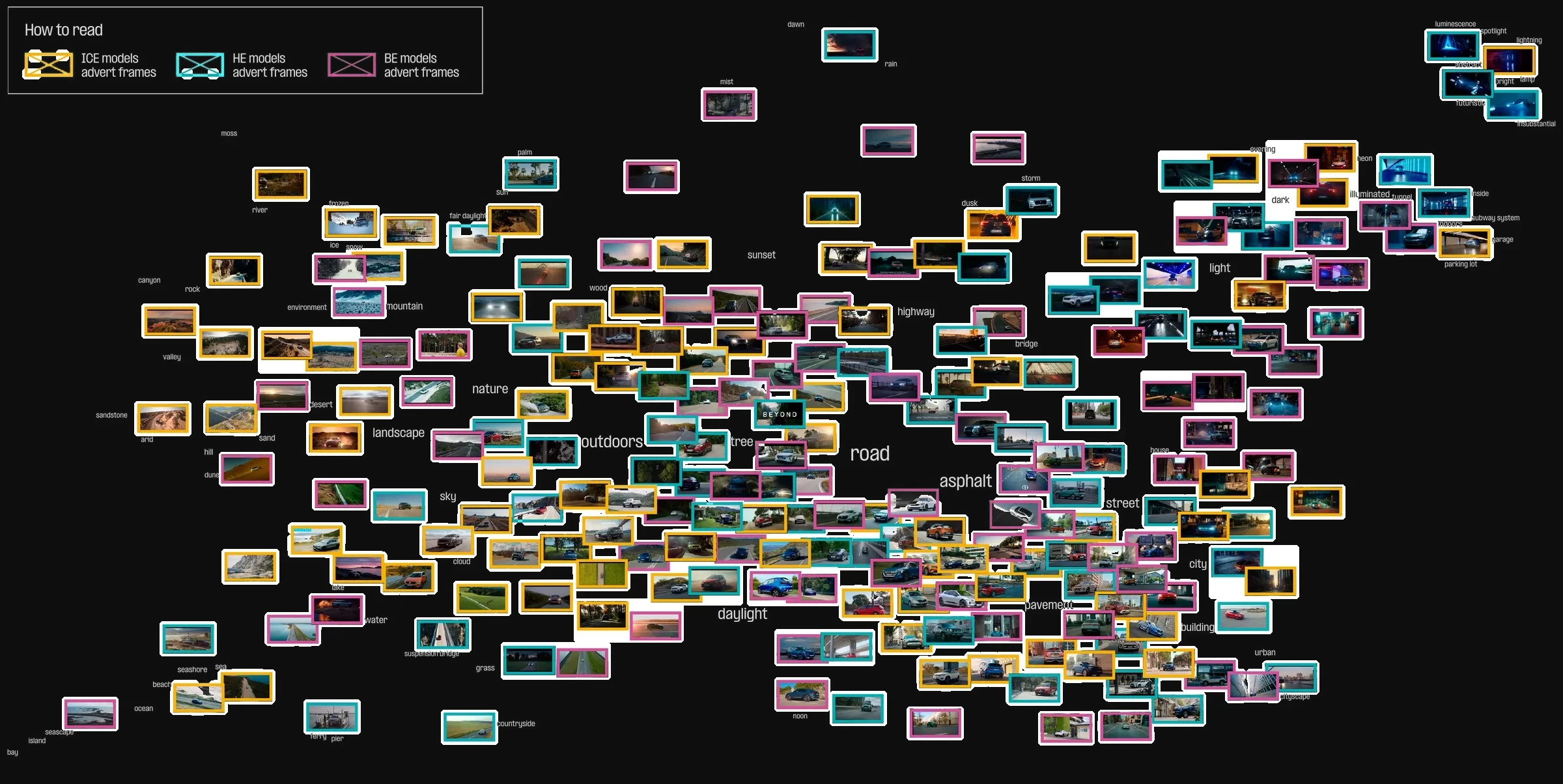
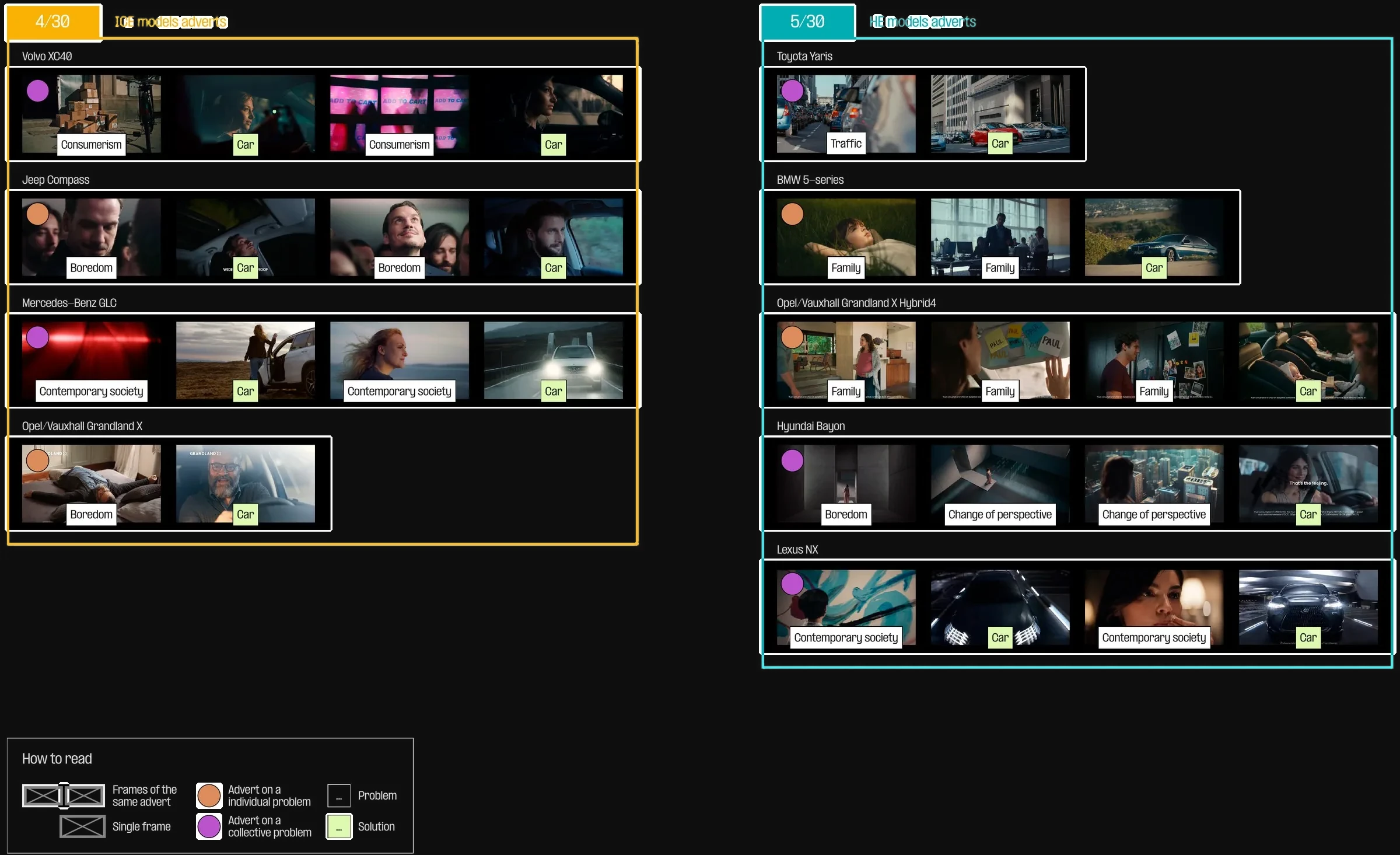
Every engine gets an empty landscape. Petrol cars get the wild, electric cars get the future.
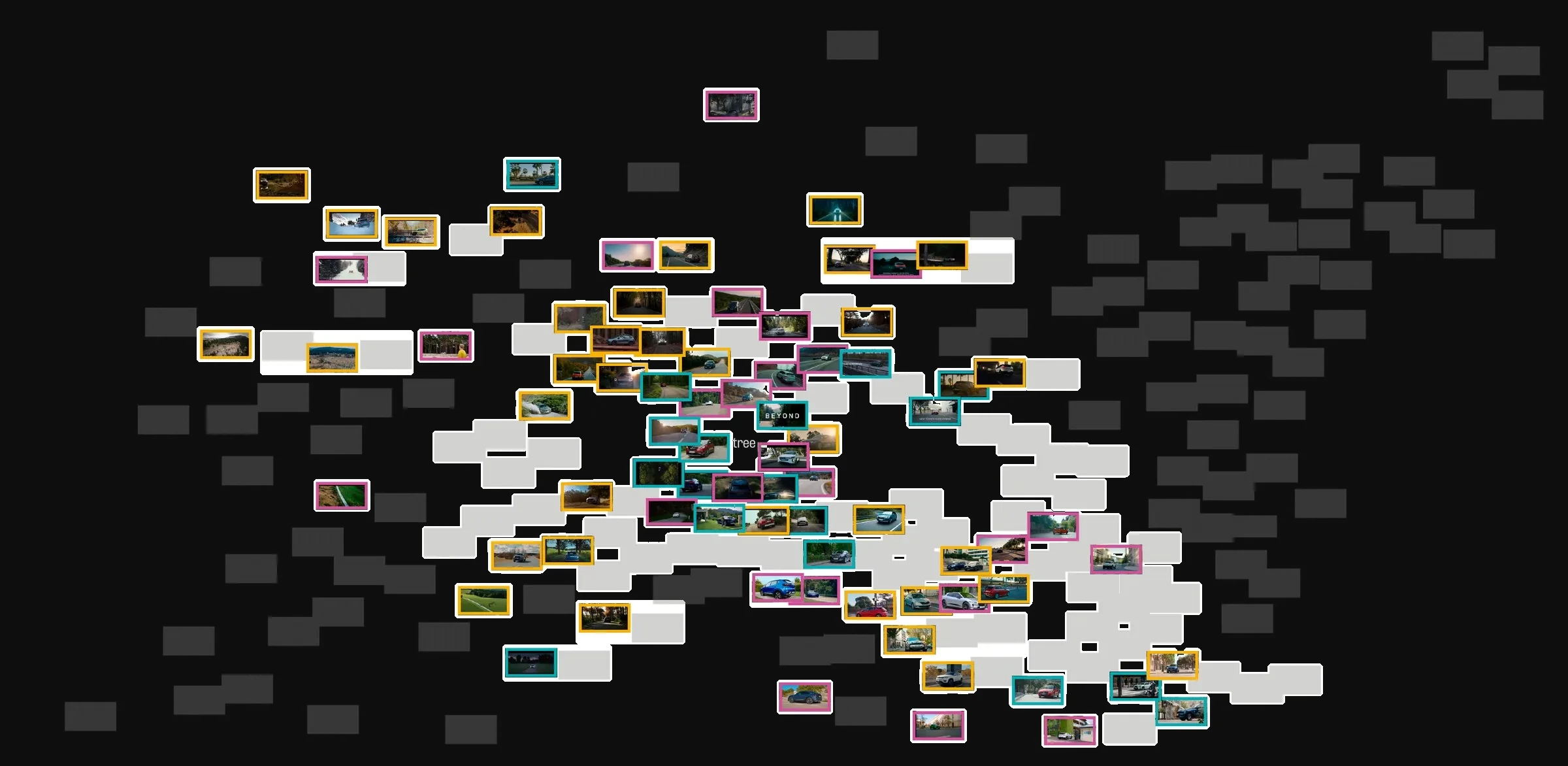
How: every advert frame, tagged by its setting and placed in a network by the tags it shares.
Key finding · Finding 04
Trees appear in more than one third of the scenes. Right after road, asphalt, outdoors and daylight, tree is one of the most common elements, with 78 occurrences, even in urban settings.
Question 02 · Narrative strategies · 4 findings
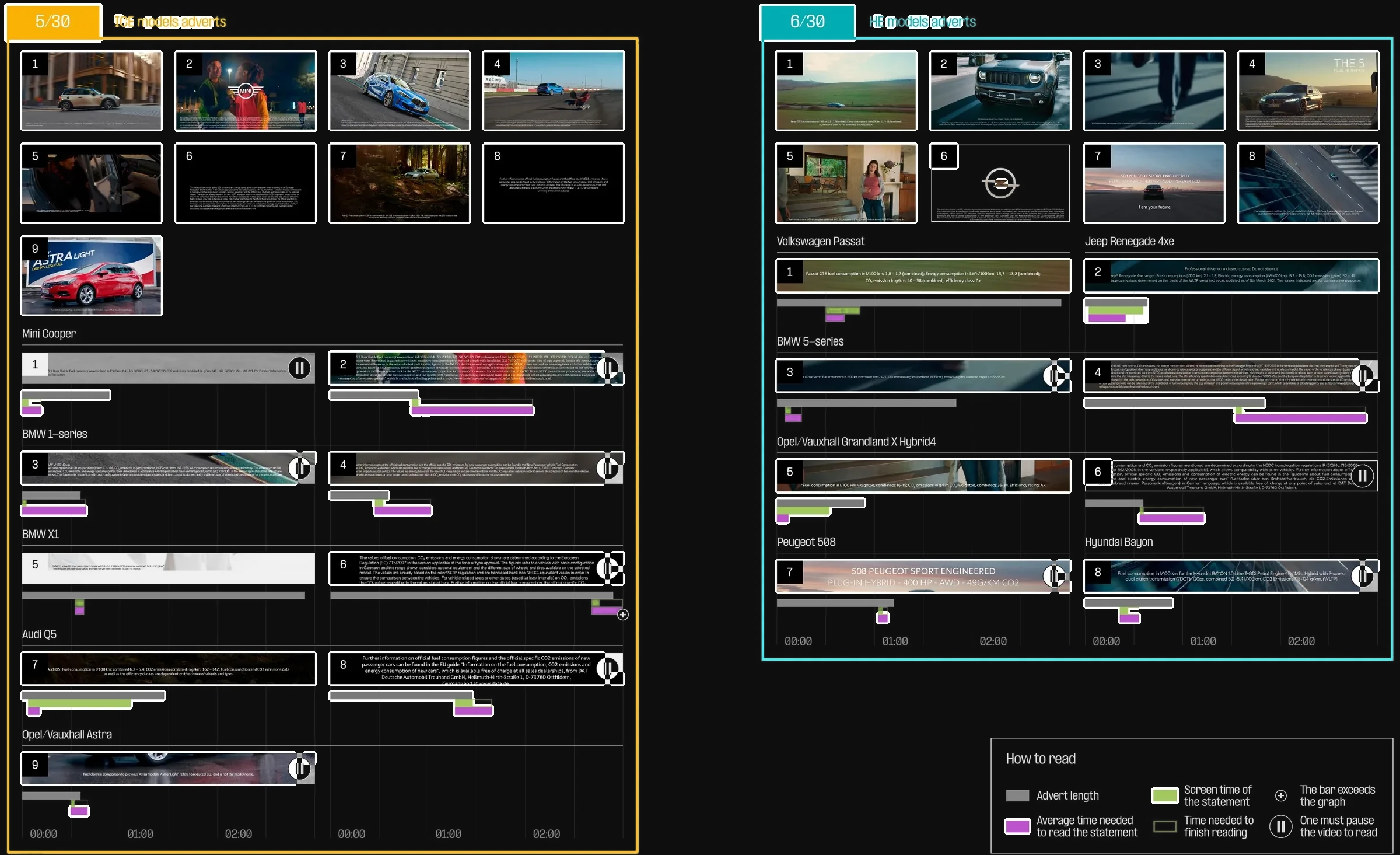
The fine print is there. It just leaves before you can read it.
How: every advert storyboarded; similar sequences clustered, named and ranked by how often they appear.
Key finding · Strategy 4 · Finding 04
If included, most adverts don’t give enough time to read emissions and consumption information. It sits at the very end, in a small block of text, often shown for less time than reading needs.
The values of fuel consumption, CO2 emissions and energy consumption shown were determined according to the European Regulation (EC) 715/2007 in the version applicable at the time of type approval. The figures refer to a vehicle with basic configuration in Germany and the range shown considers optional equipment and the different size of wheels and tyres available on the selected model. The values are already based on the new WLTP regulation and are translated back into NEDC-equivalent values in order to ensure the comparison between the vehicles.
1 s
on screen · that was it
1:05
needed to read it
One advert’s fine print, verbatim, shown for as long as the advert shows it. Measured with OCR, Read-o-Meter and The Read Time.
Question 03 · Descriptions · 5 findings
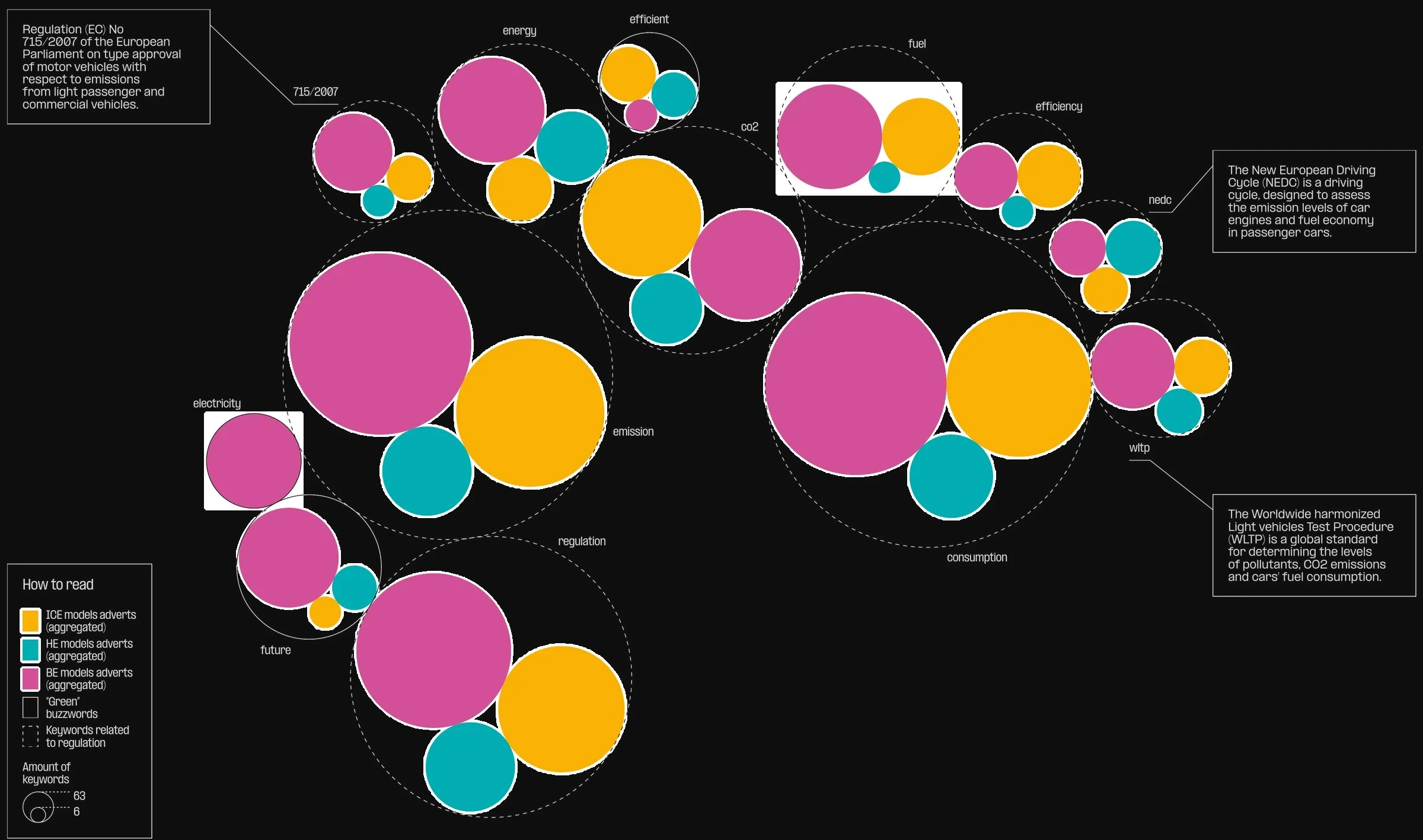
In writing, brands talk compliance, not ecology.
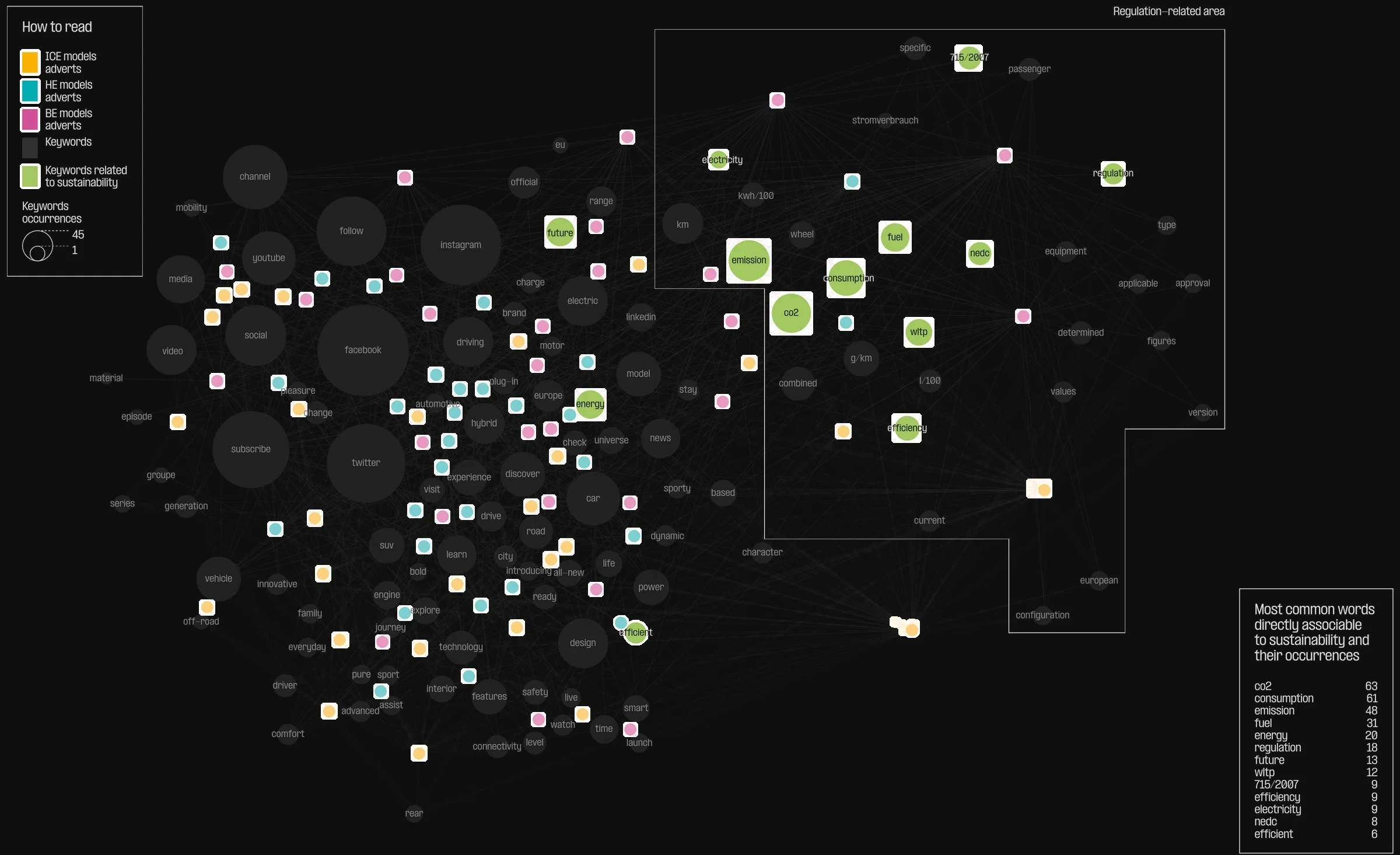
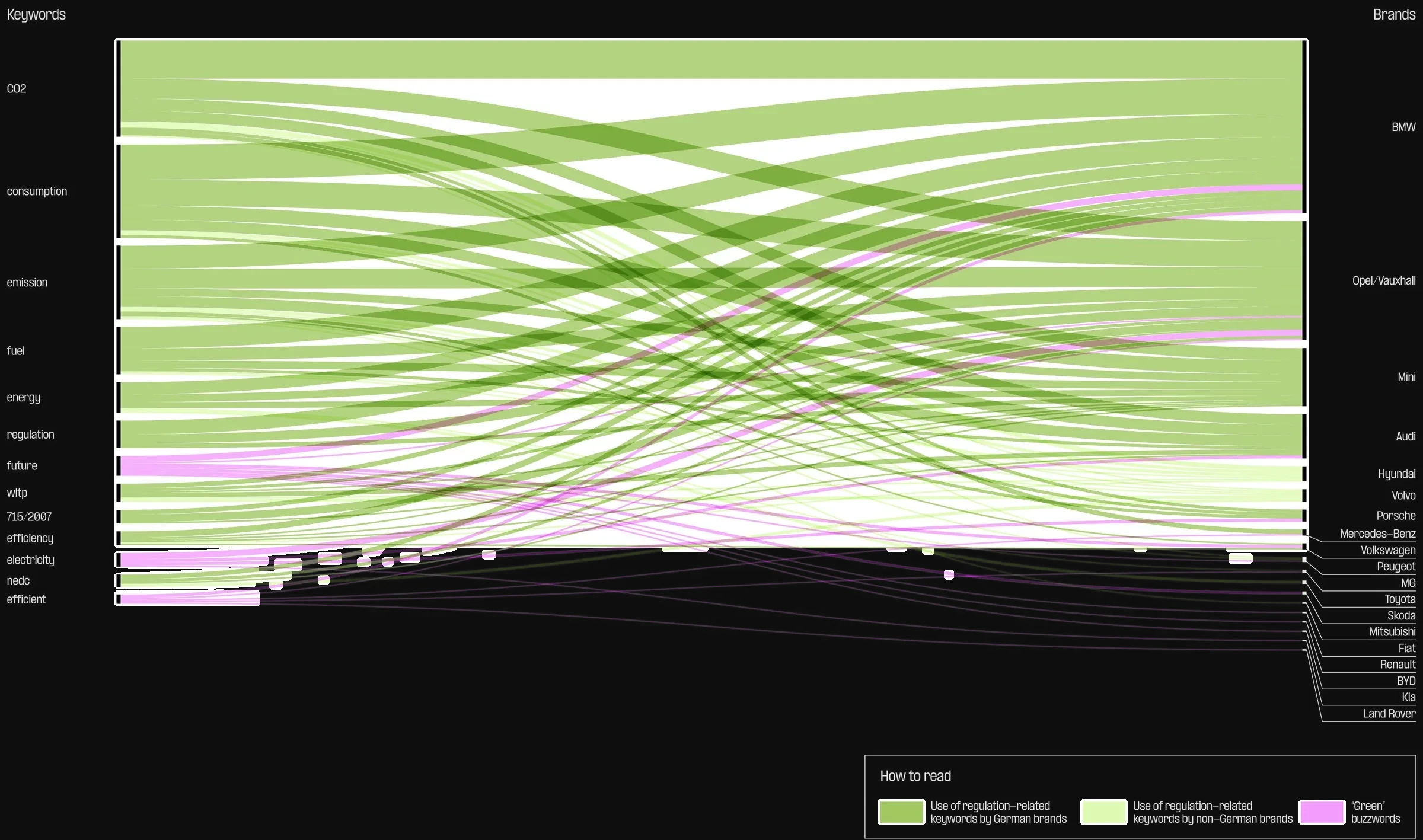
How: sustainability keywords in the 90 YouTube descriptions, counted by engine and by brand.
Key finding · Finding 01
Typical “green” buzzwords are uncommon and context-dependent. A separate area of regulation keywords suggests brands prefer to stress compliance with standards rather than make bold claims.
The other ten findings 10 findings · 12 charts, by question
Q1 · Finding 01
Most adverts show the models in similar environments
Idealised landscapes, almost always without people.
Q1 · Finding 02
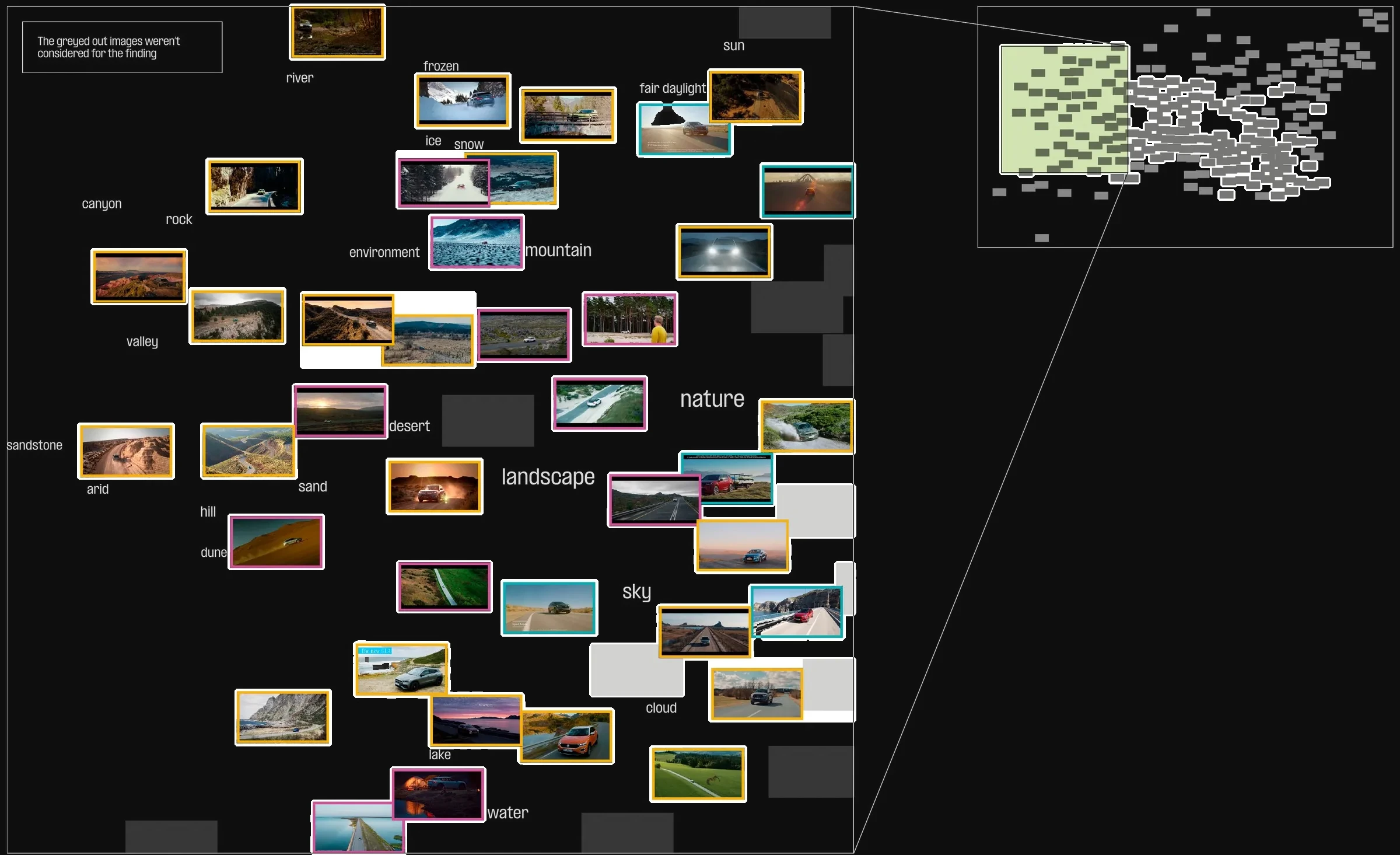
Many petrol-powered SUVs are shown in wild and uncontaminated areas
Deserts, seashores and mountains, usually in broad daylight.
Q1 · Finding 03
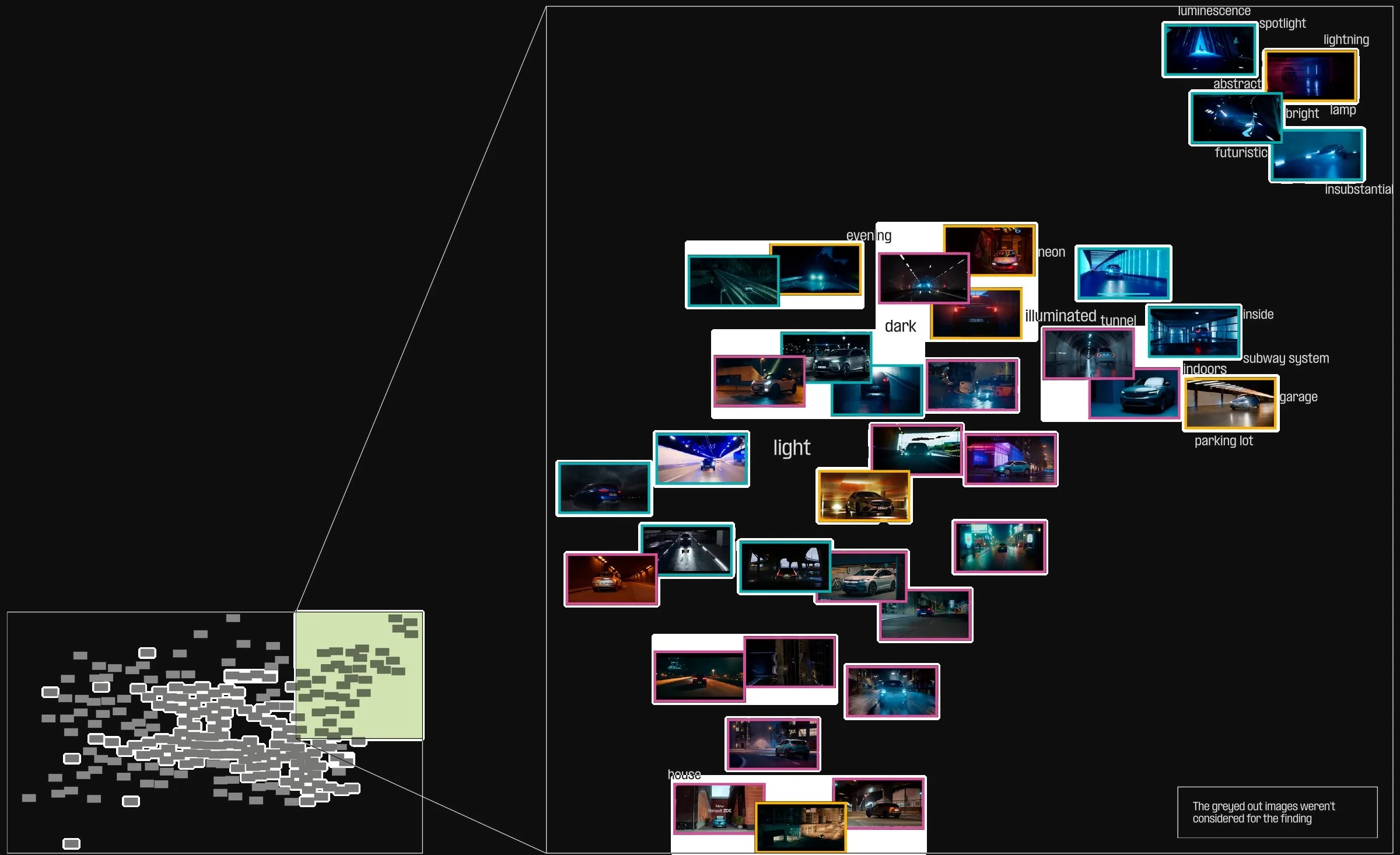
Many electric and hybrid vehicles are shown in futuristic and urban contexts
Usually by night. Brands emphasise their technology instead, even through computer-generated imagery.
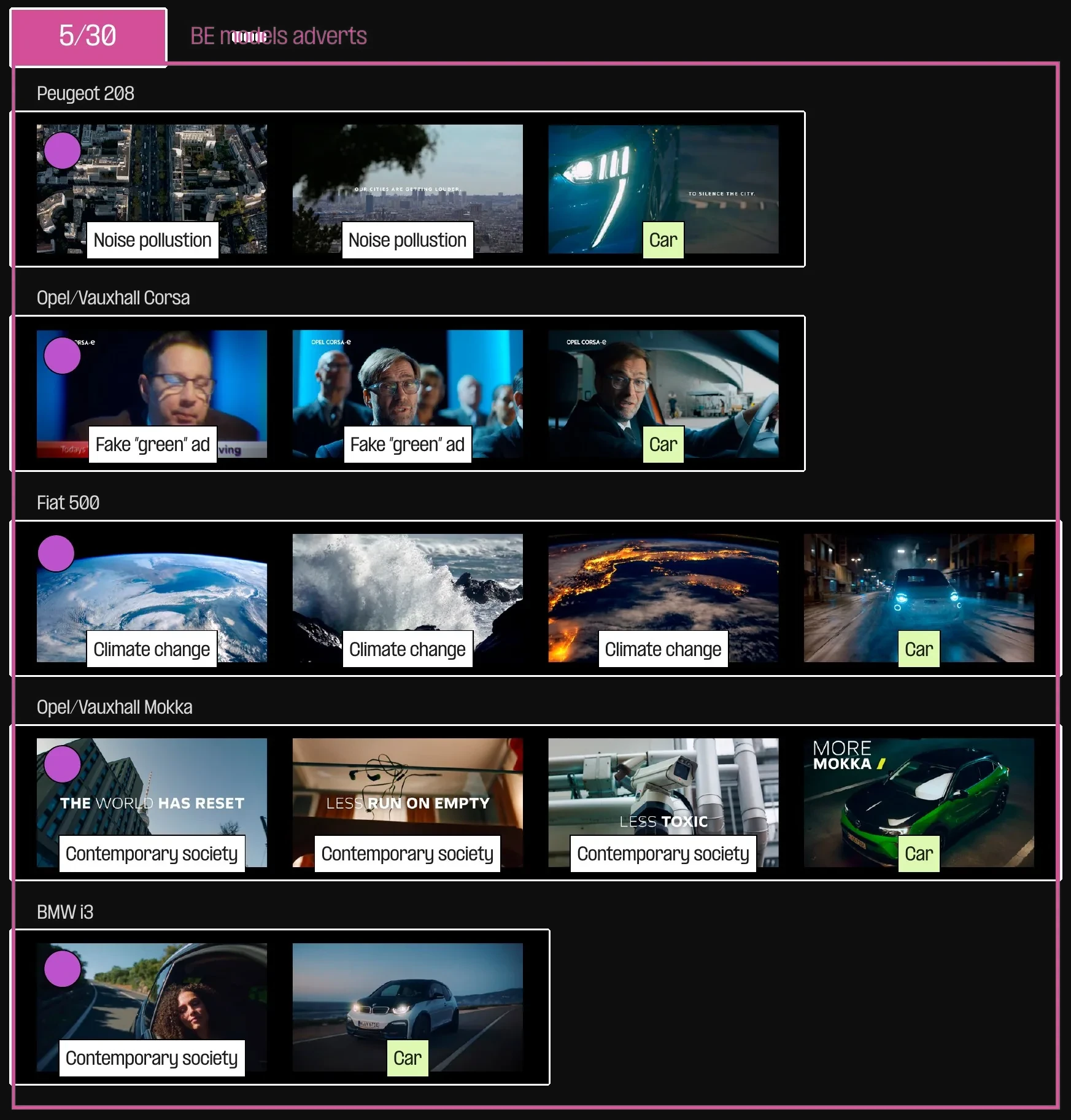
Q2 · Strategy 1 · Finding 01
Fighting climate change by buying a new electric vehicle
Electric adverts often open on consumerism, noise pollution or climate change, and present the car as their embodied solution.
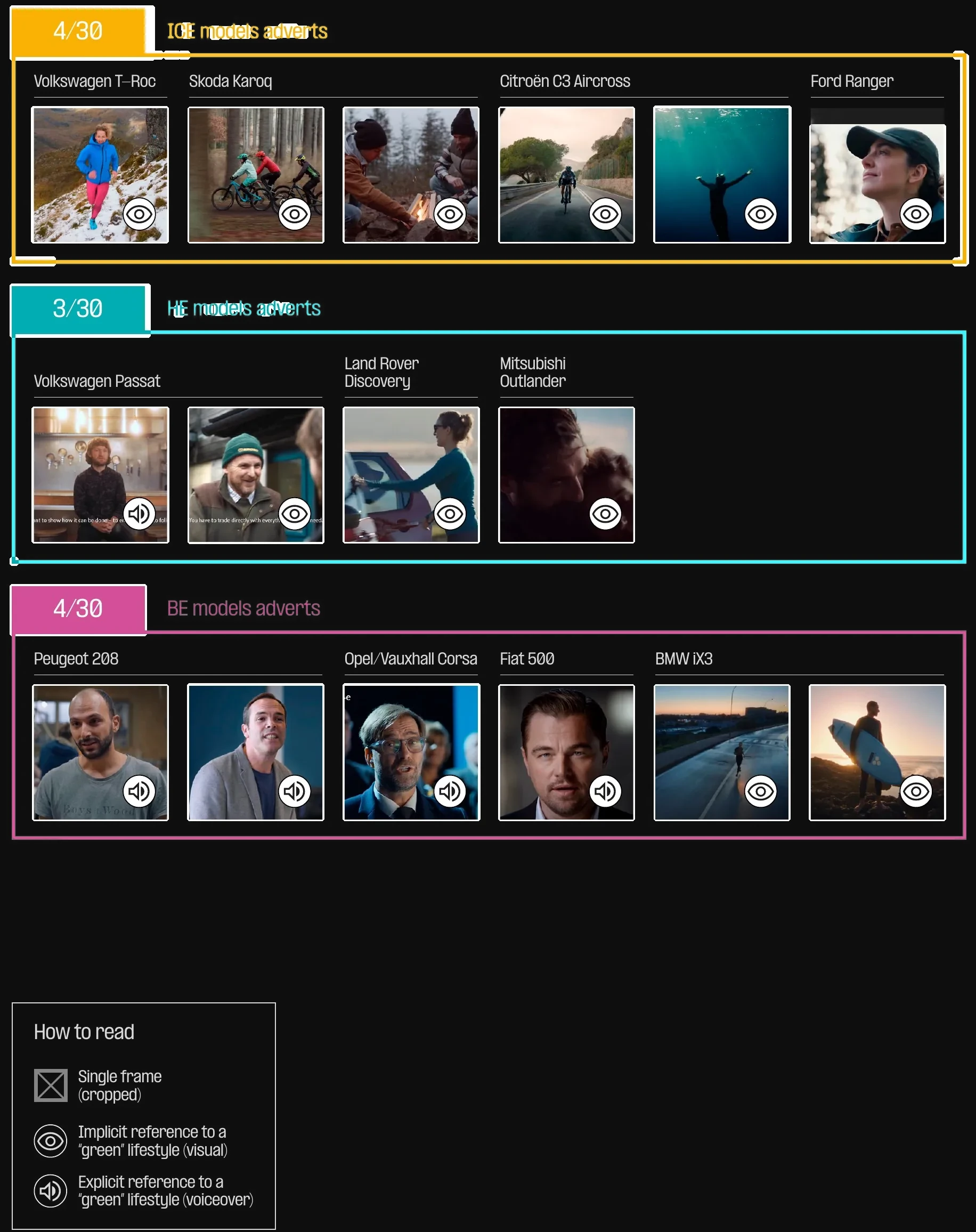
Q2 · Strategy 2 · Finding 02
Electric and hybrid vehicles as an expression of a more sustainable lifestyle
The car becomes an expression of a sporty, green lifestyle.
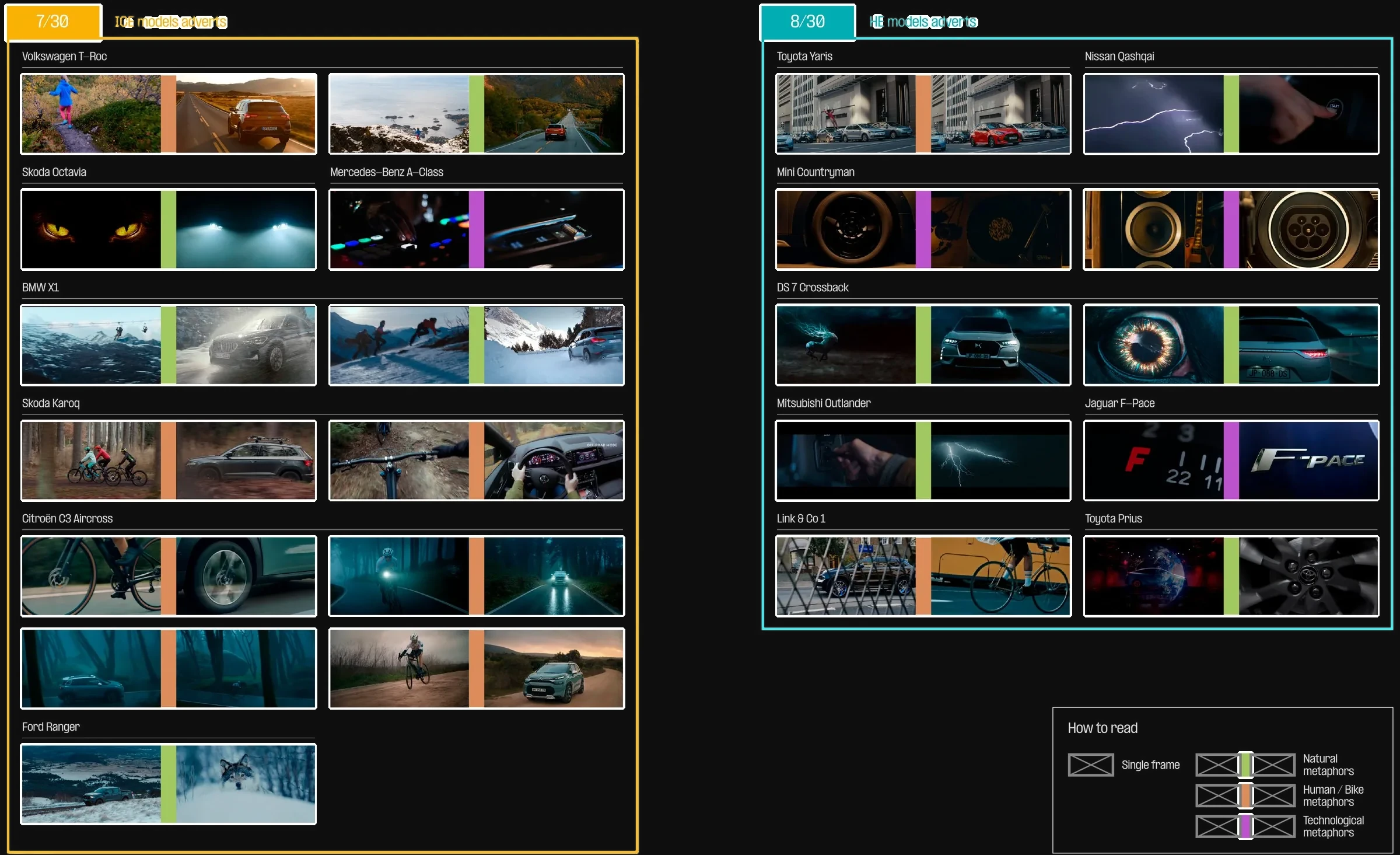
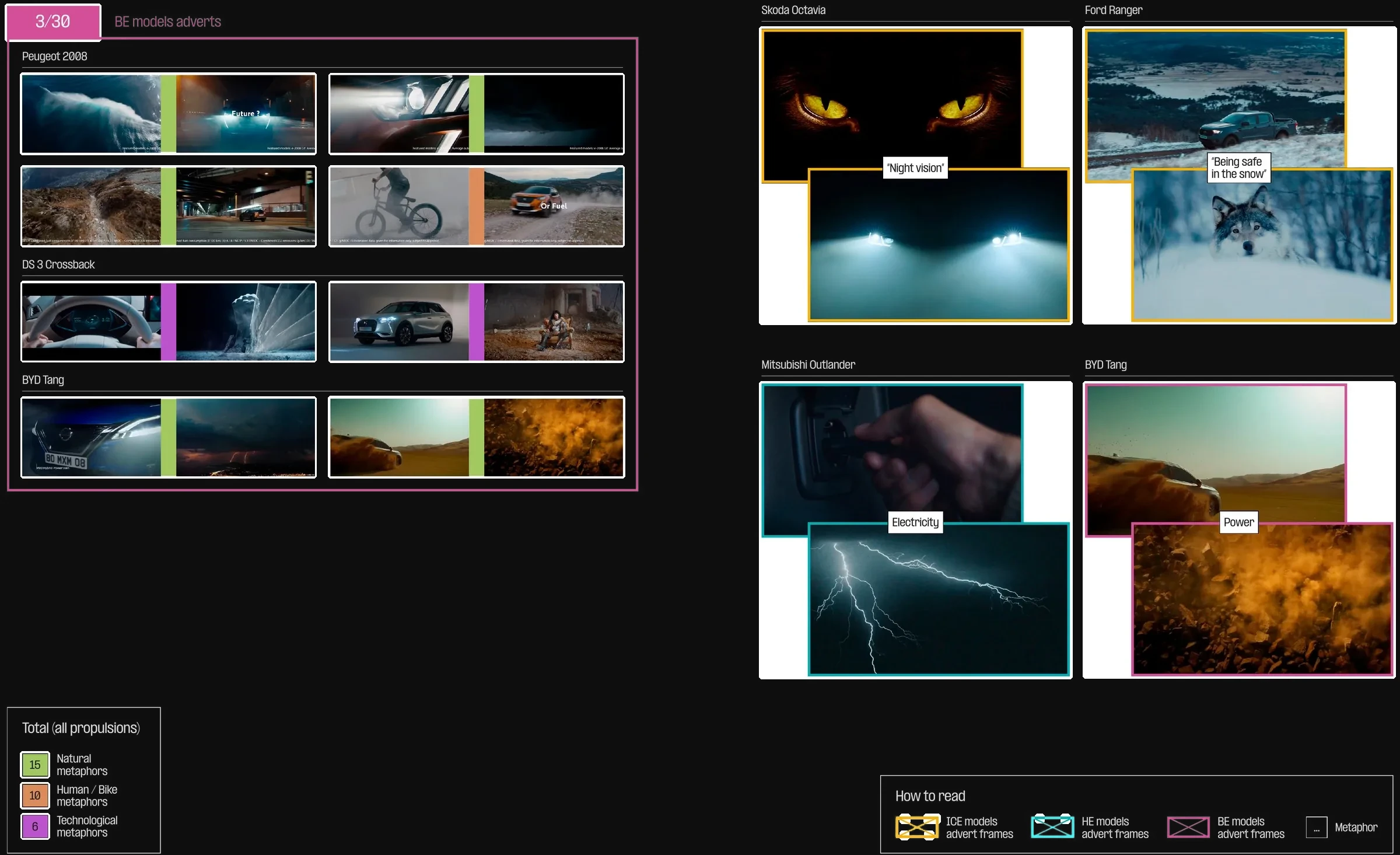
Q2 · Strategy 3 · Finding 03
Rhetorical associations between vehicles and nature are common among all propulsion types
Natural, human or technological pairings.
Q3 · Finding 02
ICEVs and BEVs share the same amount of regulation-related keywords
Petrol and electric models get the same attention in regulation statements across brands; hybrids don’t.
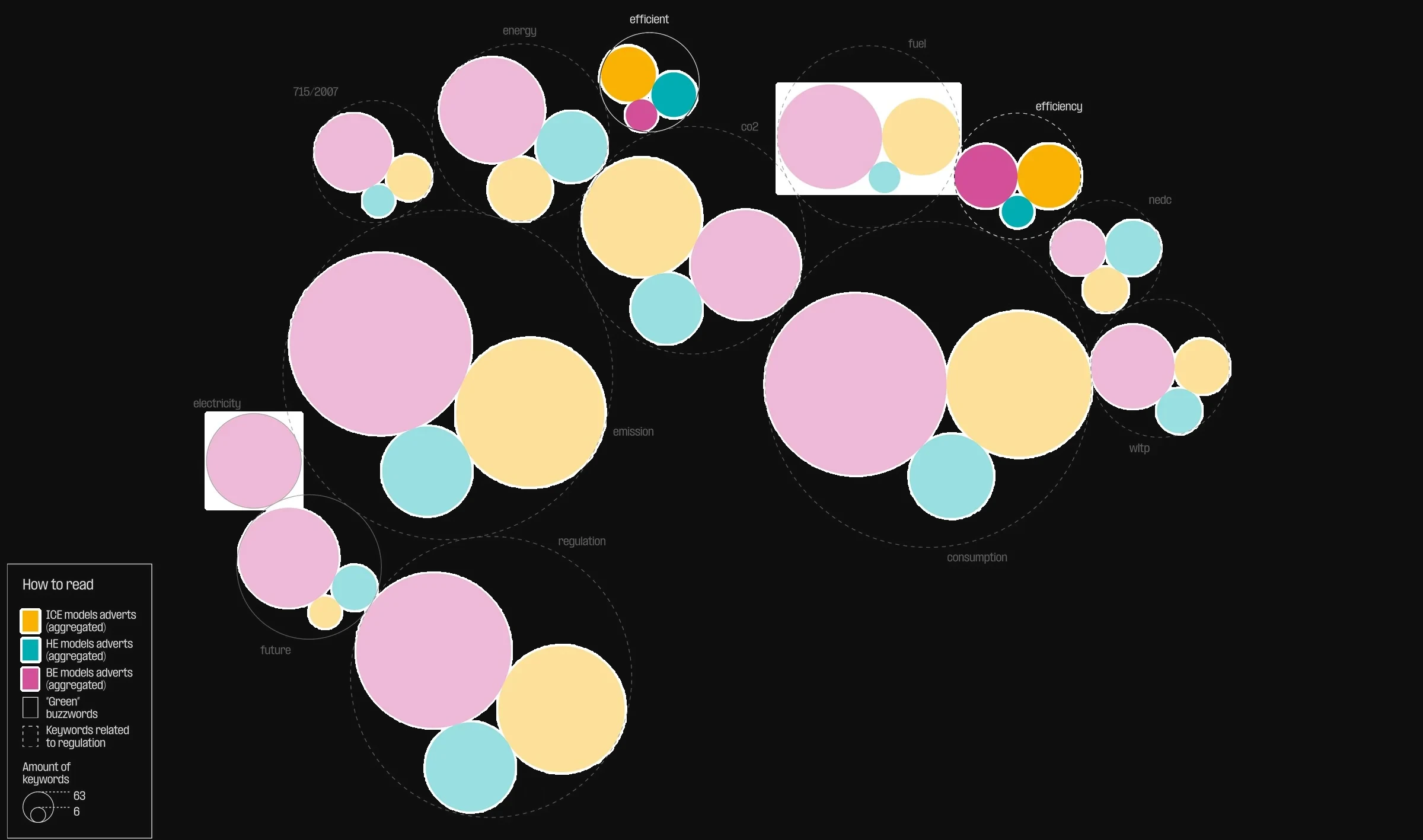
Q3 · Finding 03
The usage of “efficient” is completely different from “efficiency”
“Efficiency” appears in regulation statements; “efficient” describes the green properties of petrol and hybrid engines.
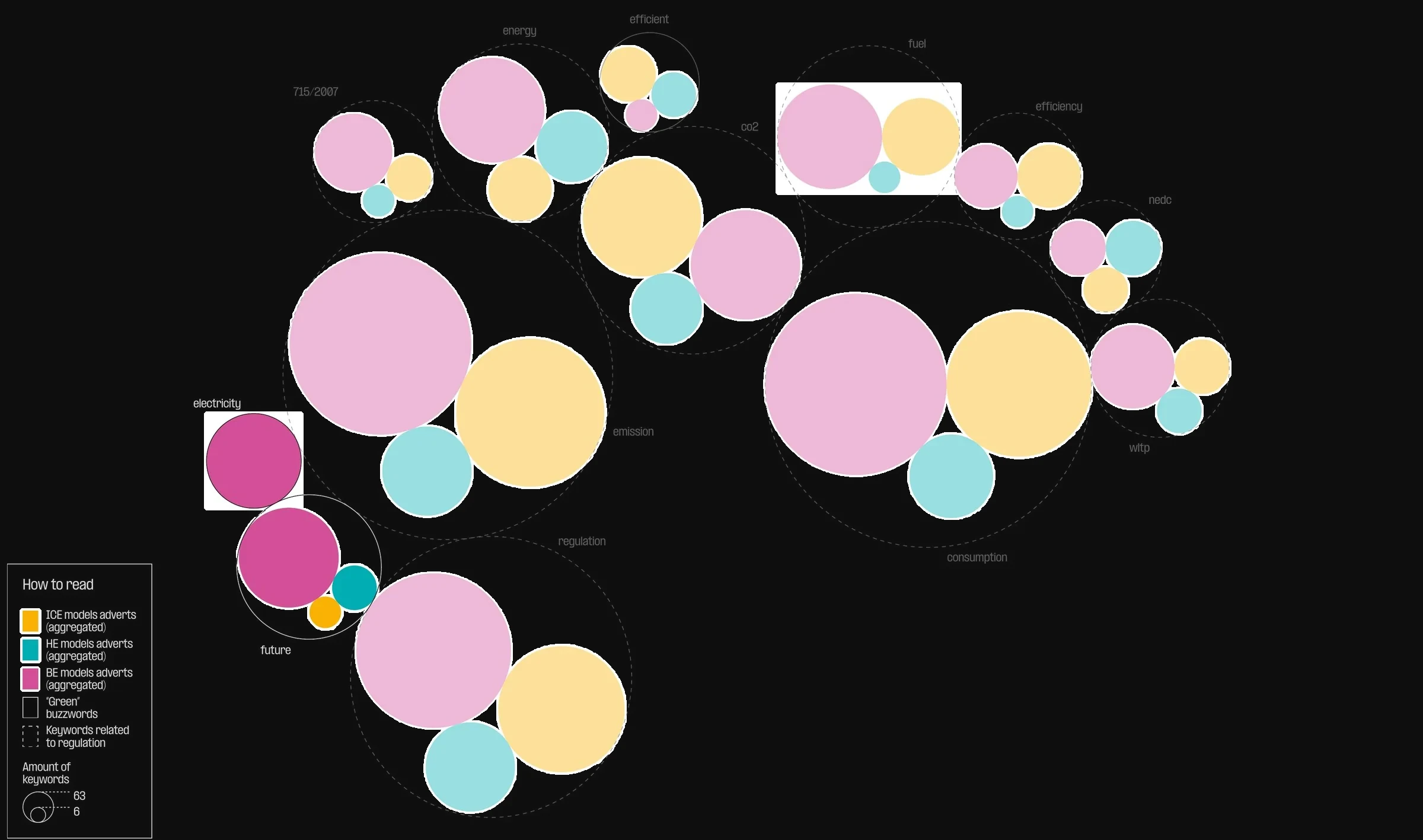
Q3 · Finding 04
“Electricity” and “future” are mostly used for electric vehicles
For electric cars, brands rely on “green” buzzwords more than for any other propulsion type.
Q3 · Finding 05
Most of the car brands that cite regulations are German
BMW, Mini, Opel and Audi stress compliance most.
Question 01 · Environments
Question 02 · Narrative strategies
Question 03 · Descriptions
Select a chart to open it full size
Method, glossary and protocols how the 90 were chosen · 4 terms · 3 protocol flowcharts
From a ranking of all models sold in Europe in 2021, we kept brands with a global or European YouTube channel, checked which powertrains existed before the end of Q2 2021, and capped each brand at three petrol or hybrid models and two electric ones.
| ICE / ICEV | Internal combustion engine (vehicle): petrol or diesel |
| HE / HEV | Hybrid electric (vehicle) |
| BE / BEV | Battery electric (vehicle) |
| NEDC / WLTP | European and worldwide test procedures for emissions and fuel consumption |
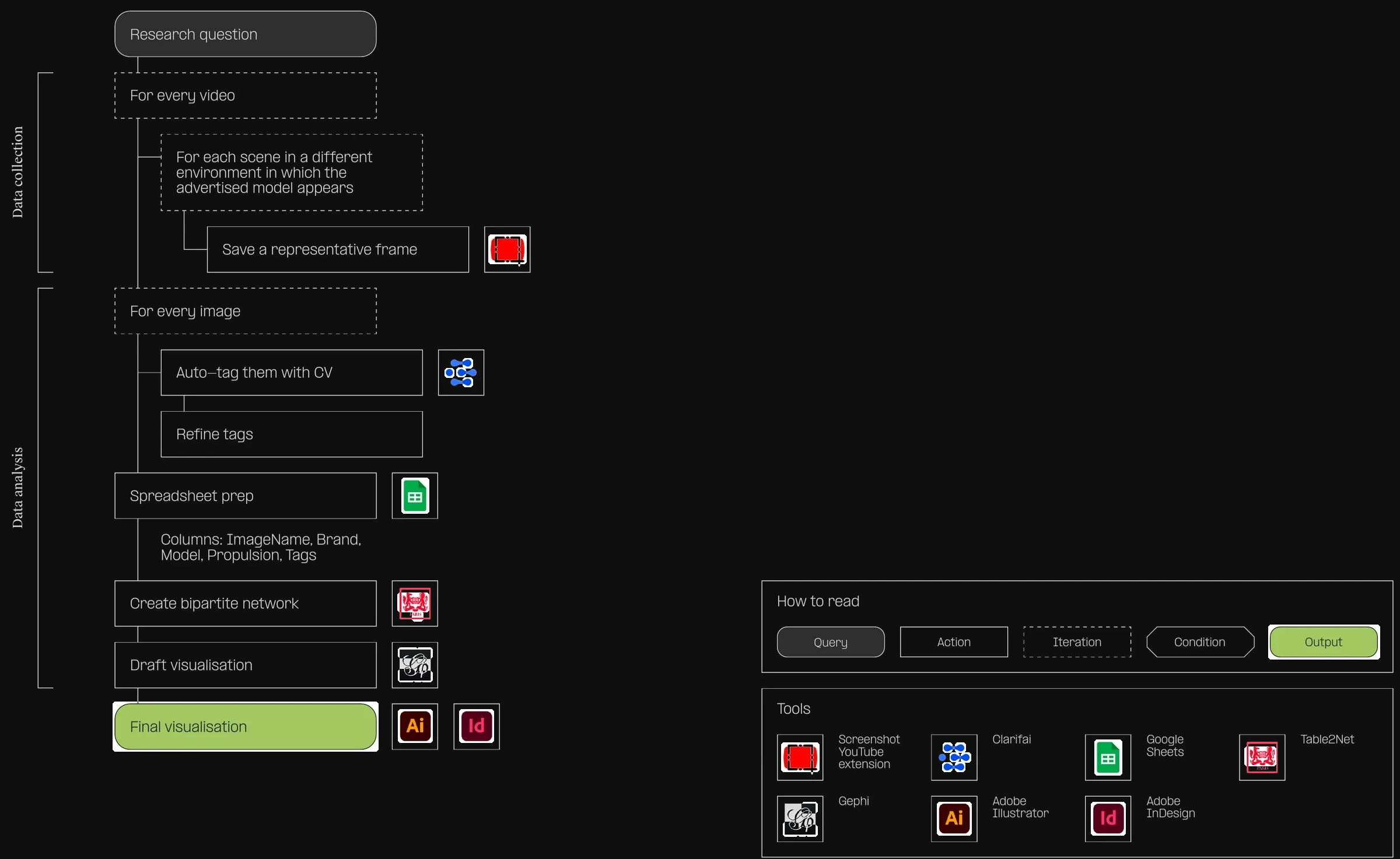
Question 01
Screenshot extension, Clarifai, Table2Net, Gephi
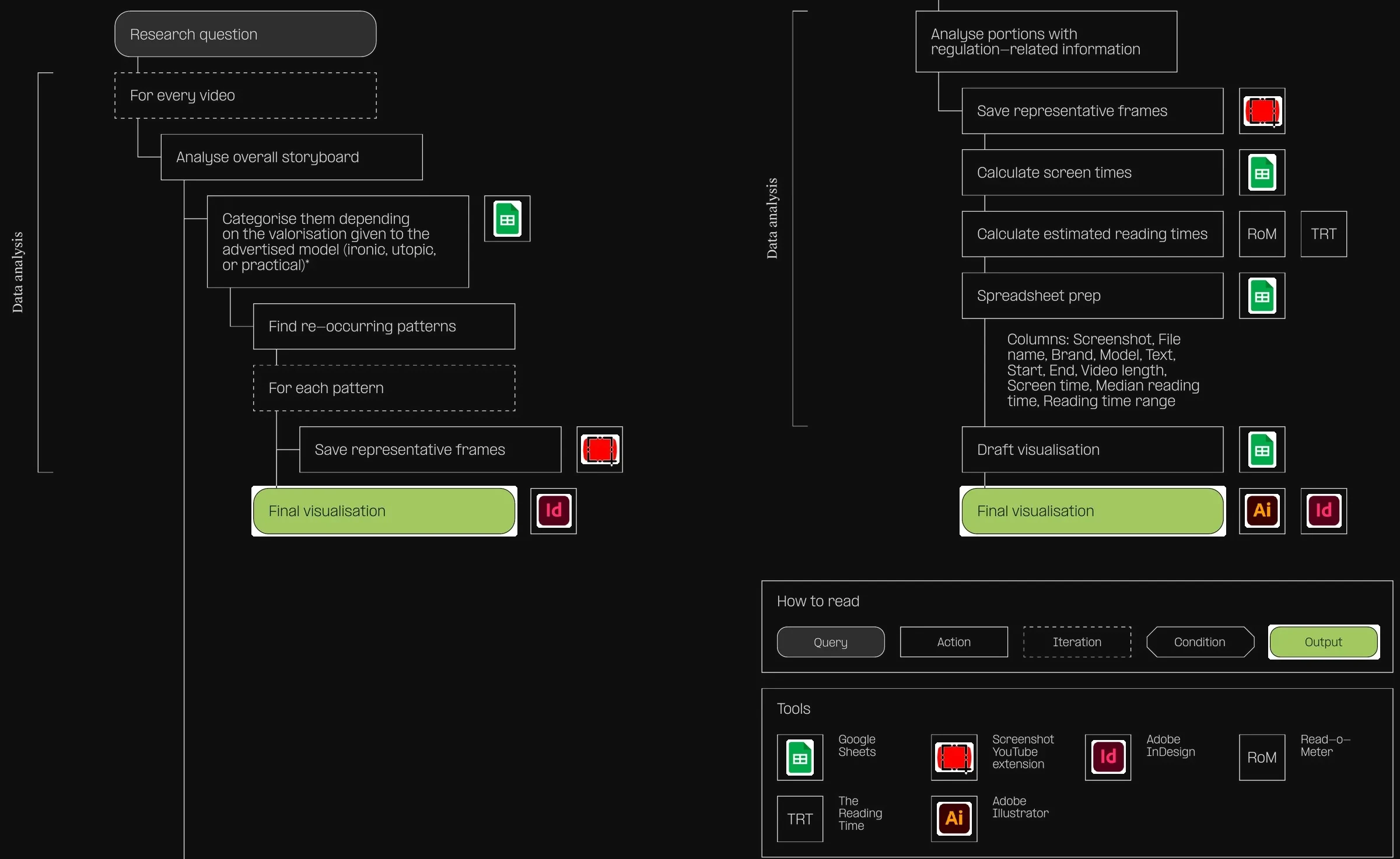
Question 02
Storyboards, Read-o-Meter, The Read Time
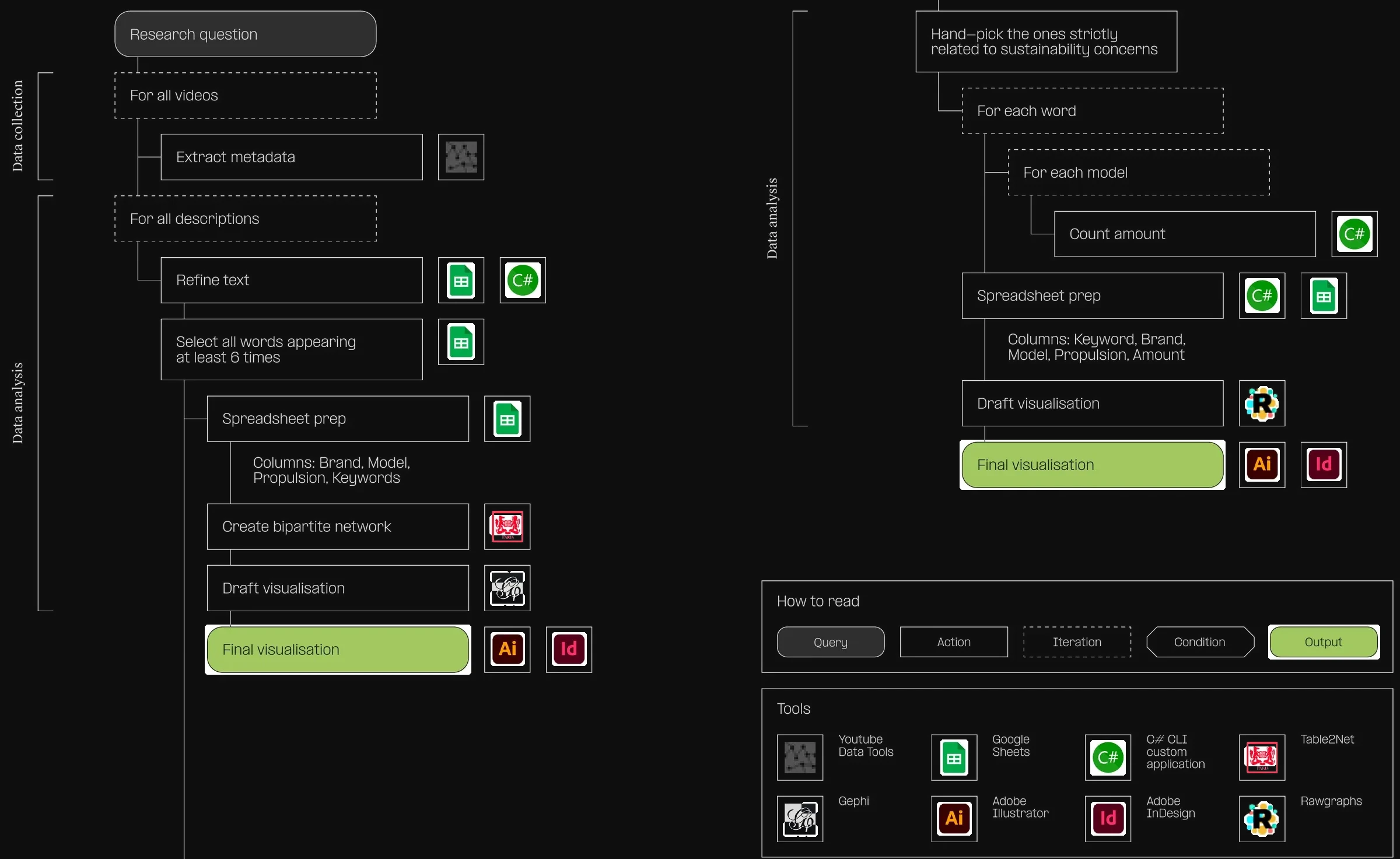
Question 03
YouTube Data Tools, custom C# app, RAWGraphs
The report’s design 3 rules to make dense evidence readable · 3 pages
The report had to hold every finding without becoming a wall. Our team agreed on three rules and applied them on every page.
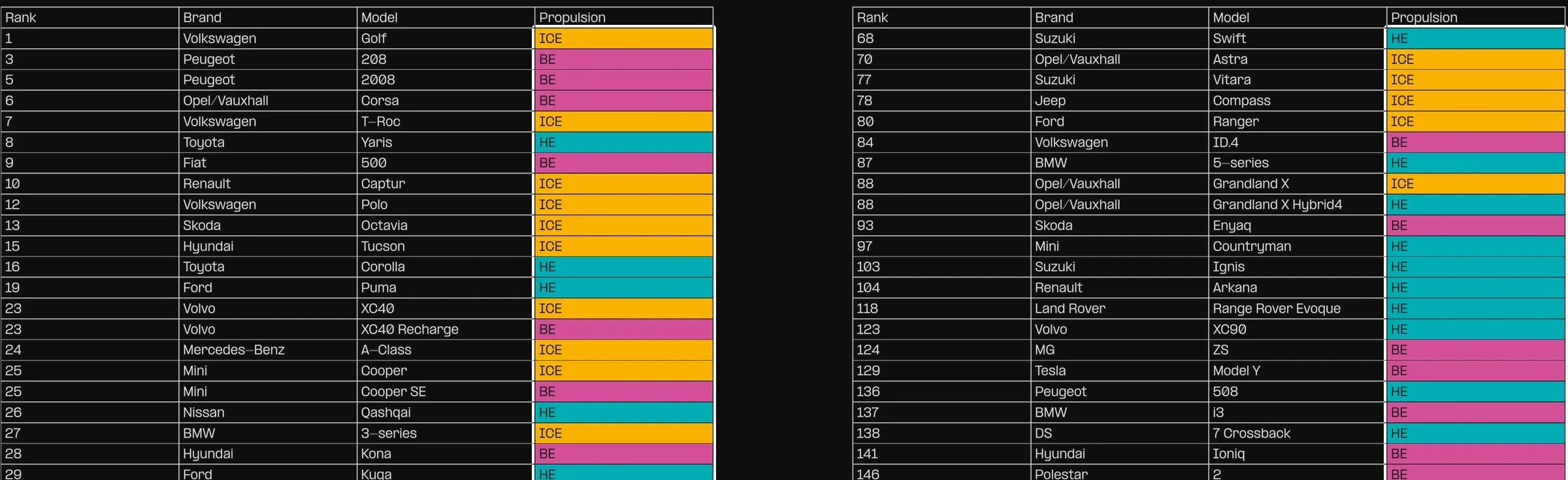
01 · One colour per propulsion, everywhere
Yellow for petrol, teal for hybrid, magenta for electric: the same code outlines frames, fills tables and labels boxes.
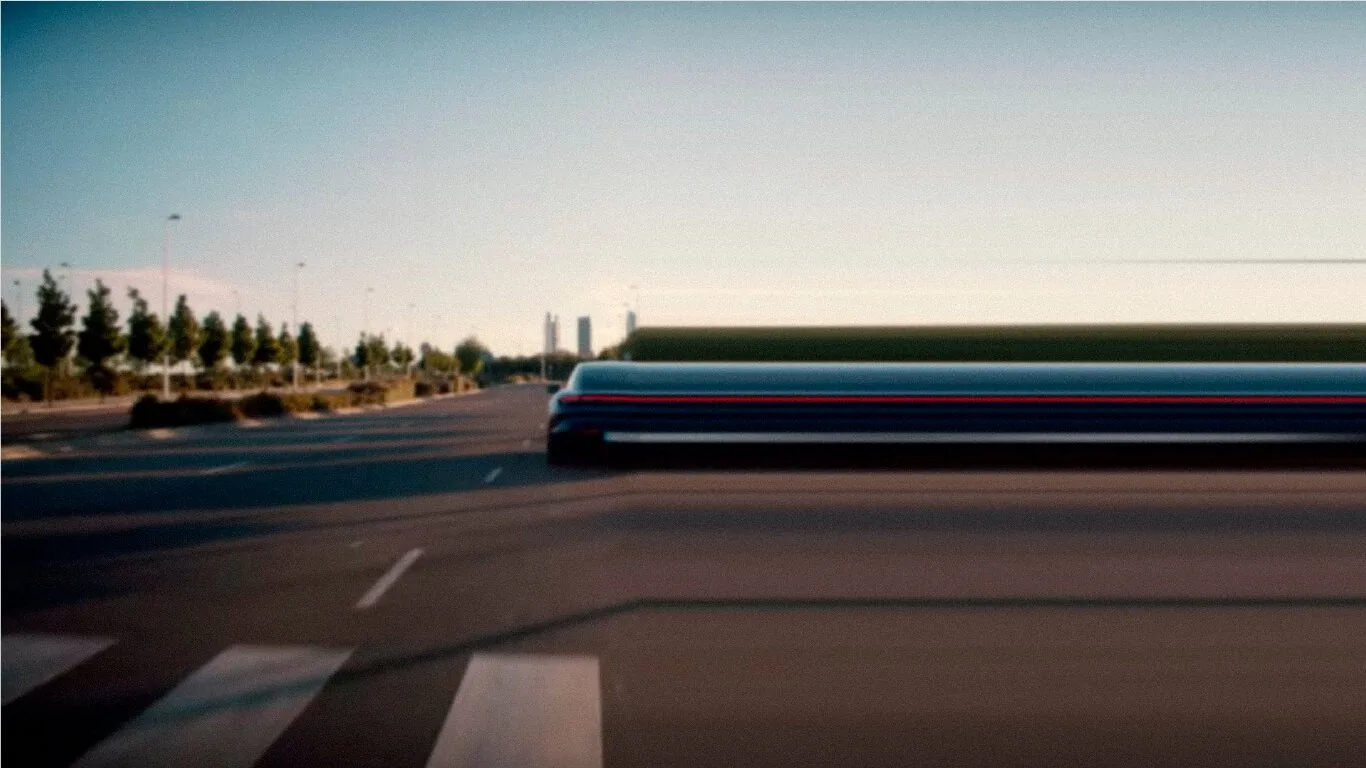
02 · Motion blur opens each question
The car, and its message, gone before you can look at it. The same treatment became the cover.
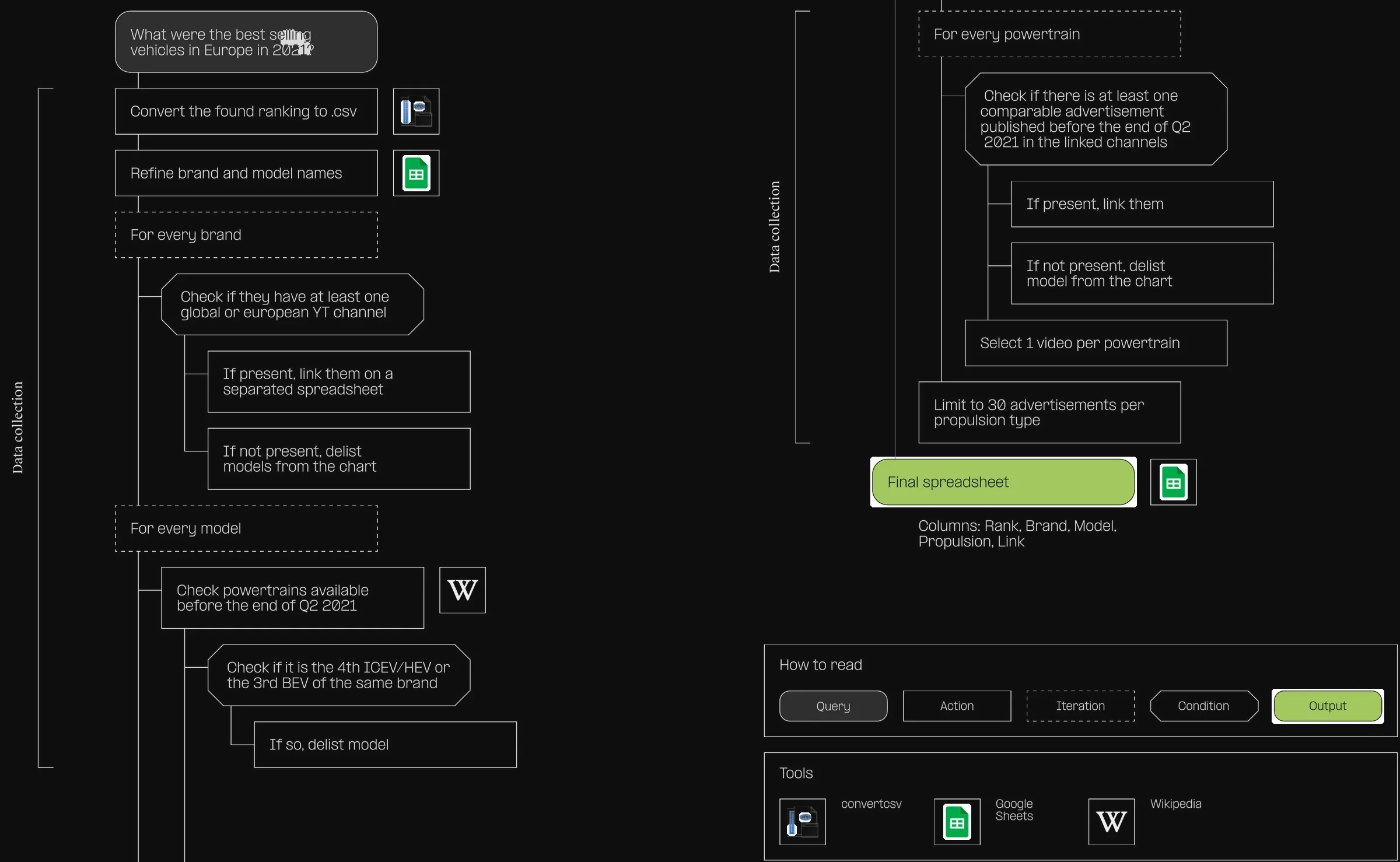
03 · Every chart explains itself
A “How to read” legend sits beside every chart, and each question ends with a flowchart of its protocol.
03 — Make clear
Take each pattern out of its advert, and it stops working.
The report was written for experts. To reach drivers, we needed fewer patterns and no reading. Inside an advert, these patterns pass unnoticed. Cut out and repeated across brands, they become obvious. Automotifs is built for car owners, buyers and anyone interested in the energy transition: recognise the patterns, reflect, form an opinion.
The report and Automotifs use different categories. The report counts narrowly defined findings; the four collages follow broader strategies across the same 90 adverts, so their counts describe different selections.
Pristine environments · 90 / 90 adverts
Erase the car, and the landscape is the message.
Green metaphors · 20 / 90 adverts
Split the metaphor, and the comparison shows its seams.
A metaphor works because its two halves are cut together. We split them into two synchronised tracks: nature on the left, the car on the right.
Green lifestyles · 17 / 90 adverts
Frame the person, and the car becomes an accessory.
Characters ordered from people outdoors to influencers talking about sustainable living. A green box follows each one, moving attention from the car to who is selling it.
Regulatory statements · 19 / 90 adverts
A second on screen, a minute to read.
Excerpts from the four videos, counted out of all 90 adverts · watch all four on Automotifs
How each video was made
01 Tag
Pick the clips that show the pattern from the 90 storyboards.
02 Order
Plan a montage order that tells a story, not a list.
03 Cut
Cut and hand-pick the clips in Premiere Pro.
04 Manipulate
Apply the pattern’s edit in After Effects.
The Automotifs website choose · watch · read · verify · 5 screens
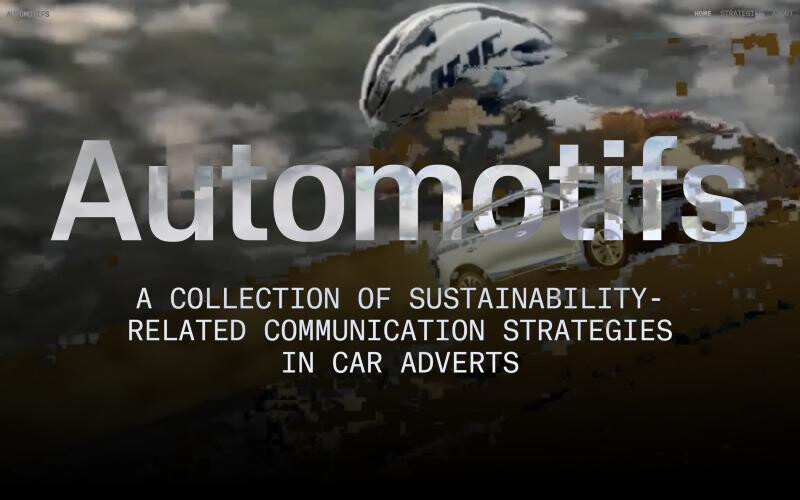
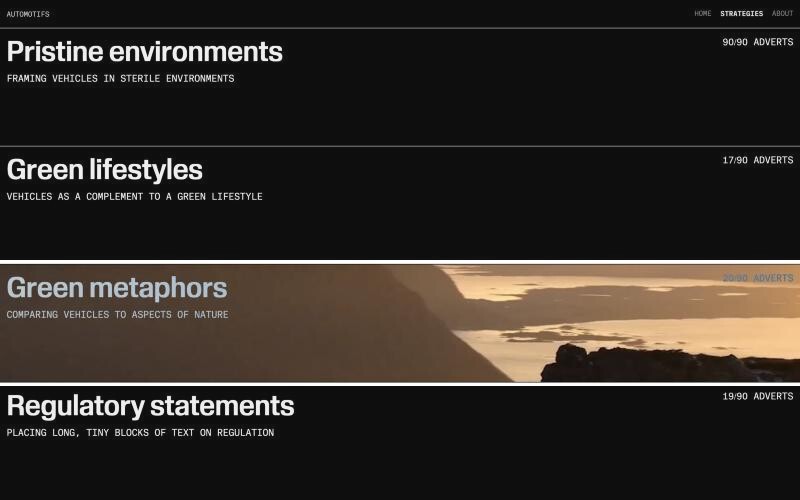
01 Choose
Four rows. Hover one and its supercut plays.
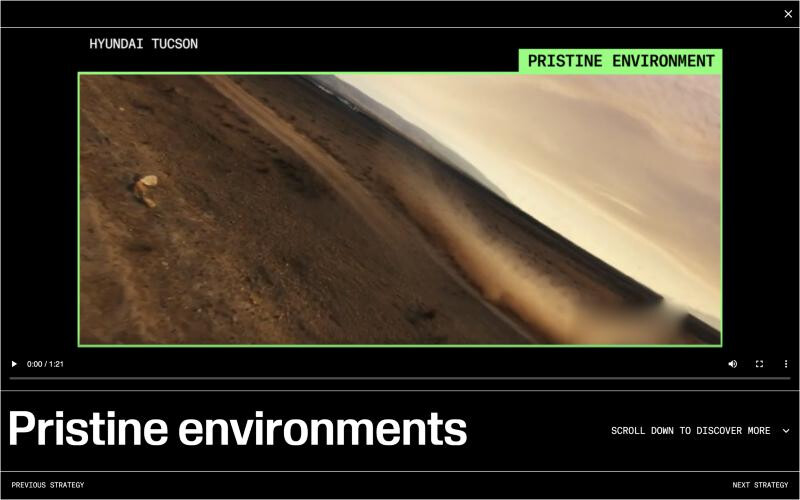
02 Watch
Each pattern opens on its full video.
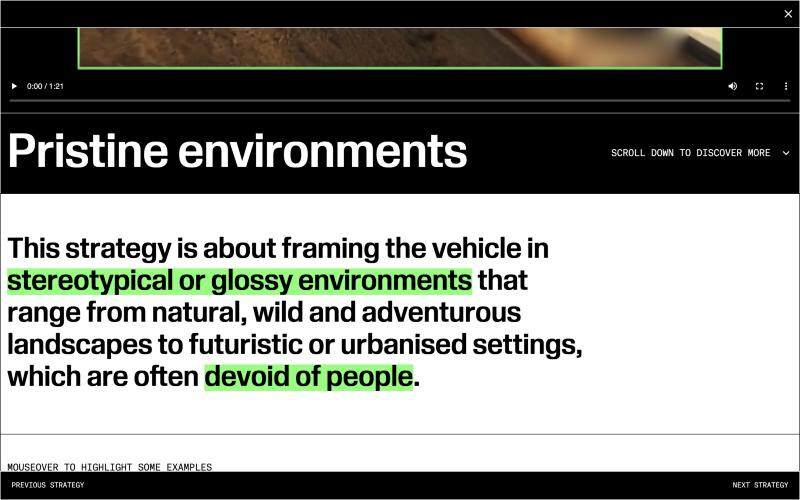
03 Read
One sentence, key words highlighted, then examples.
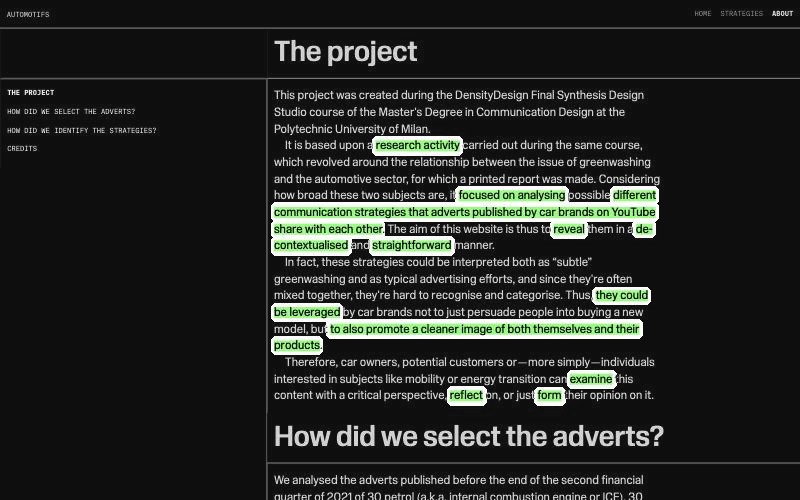
04 Verify
How the adverts were chosen, and who made it.
What it adds up to
Greenwashing isn’t always a lie. Often it’s a frame.
The pattern becomes visible when the adverts are examined together, not just one at a time. That is why the evidence had to be counted, and why the videos put the patterns side by side: so viewers can judge them for themselves.
Slow it down, and it becomes countable
Pairing computer vision with human judgement works, as long as every step is documented.
Design makes evidence readable
From storyboard to video edit, design turned patterns into something seen in seconds.
The same skill, in products
Turn messy data into clear patterns, then design so people understand them at a glance.
Next time, and credits 3 things to do differently · course · faculty · sources
Next time
Test with real viewers
Check whether drivers can name the patterns in an advert they haven’t seen.
Next time
Design for the phone first
Cut the supercuts for a vertical screen, where the adverts actually live.
Next time
Keep the dataset alive
An open archive of tagged frames, so the counts update as brands change.
| Course | Final Synthesis Design Studio, MSc Communication Design, Politecnico di Milano, Sez. C3, 2022/2023 |
| Faculty | Michele Mauri, Ángeles Briones, Gabriele Colombo, Simone Vantini, Salvatore Zingale |
| Teaching assistants | Elena Aversa, Andrea Benedetti, Tommaso Elli, Beatrice Gobbo, Arianna Bellantuono |
| Sources | Demandt, European car sales analysis 2021 (carsalesbase.com); Regulation (EC) No 715/2007; NEDC and WLTP; Collins English Dictionary |
Huge thanks to our professors and teaching assistants for their guidance, and to the whole team for the collaboration.
Next project · 05
ST deburring.
Rebrand, art direction and website redesign for a thermal deburring company working since 1979.